
I teamed up with PHEAL to produce a webinar featuring an esteemed group of speakers who imparted their perspectives on how we can achieve green space equity.
Rachel Bennett (MIG), Tiffany Eng (Raimi + Associates), and Emily Gvino (Clarion Associates) shared that advancing equitable green space access requires community-led decision-making, strategic investments in green infrastructure, and collaboration with diverse stakeholders to address climate resilience, park equity, and long-term maintenance.
There was consensus that leveraging health as a unifying lens and aligning efforts with supportive leadership, laws, and partnerships can ensure that parks and open spaces truly meet underserved communities’ unique needs.
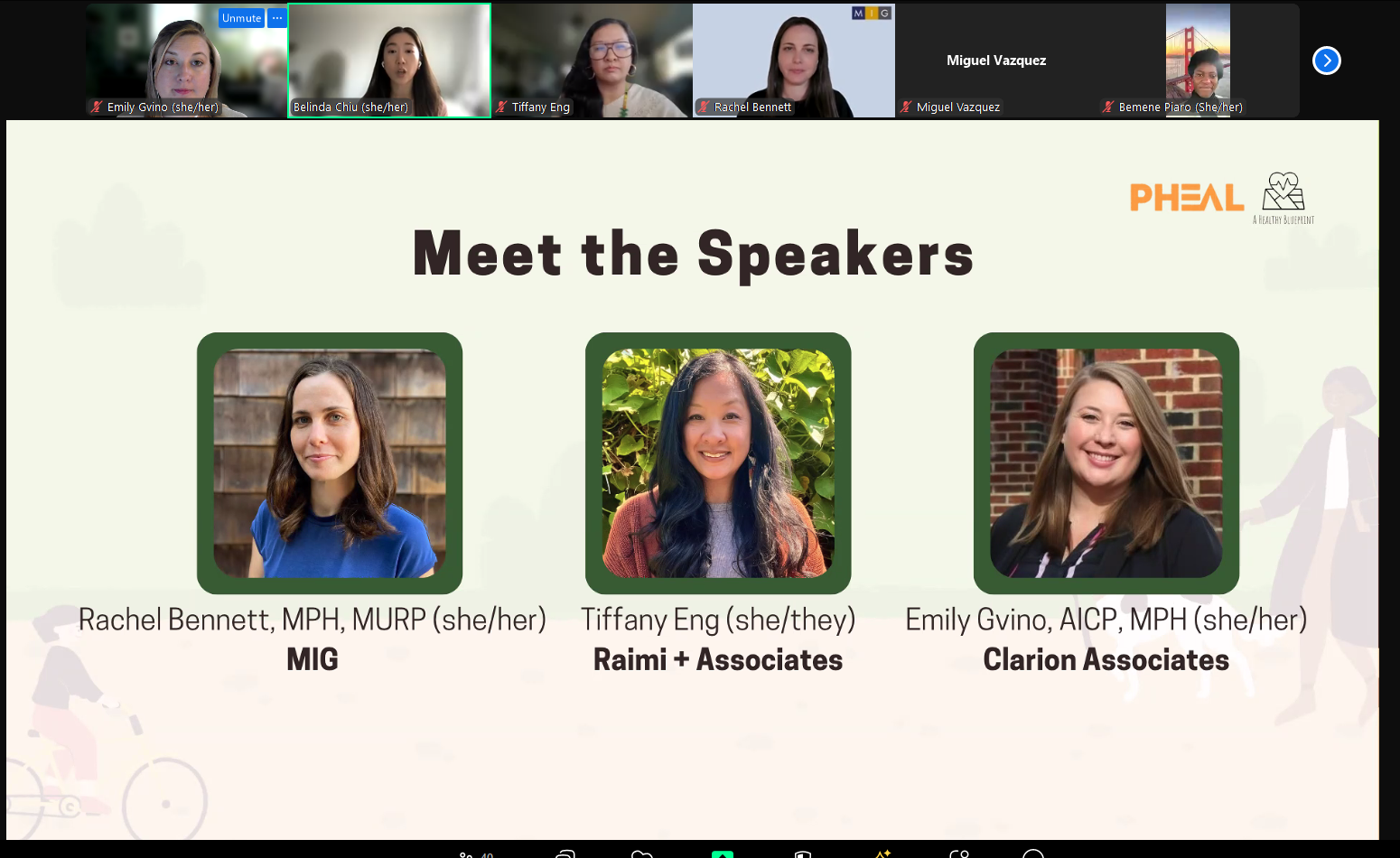
With a robust conversation during the webinar, we weren’t able to do a live Q&A (we will prioritize audience questions in future webinars), so we are sharing responses below for your convenience. Resources from the speakers and audiences are below the Q&A.
A personal note: My work as the Project Manager for PHEAL and as founder of A Healthy Blueprint is 100% volunteer-driven and unfunded. If you found this webinar valuable and want to support the continuation of these efforts, please consider making a donation to help sustain this work.
Q&A
Q: The common framing of park benefits often centers on increased property values, which raises the question of who truly benefits? How can we shift this narrative to both highlight the positive impacts of parks and address displacement in meaningful, tangible ways?
Tiffany: The story of CBE’s work in Southeast LA is a great example where CBE worked with residents to not only enhance their local parks and turn them into community-serving uses, but also organize to develop rent control ordinances for their cities. Many communities recognize that infrastructure development cannot happen in isolation, it has to be coupled with additional solutions to preserve affordable housing, etc.
Rachel: To the question of housing vs. parks: 1. A strong community-led process is crucial! and 2. Can it be a both/and? Many times, housing and parks can be combined.
Q: How can we better incorporate projects which implement and/or improve green space into municipal action plans, so that we are planning to incorporate these features into our built environment years in advance?
Rachel: I think it’s important to not silo this issue in plans/policies. Comprehensive plans have a Natural Resources or Parks element (or something like it), and that can’t be the only place these priorities live. We can include park-related strategies into other plan elements as well (e.g., safe transportation routes to parks, joint development of parks and housing, parks as emergency response hubs, etc.).
Tiffany: Most research and literature says that planned actions are more likely to correlate with implementation. Raimi + Associates developed a SB 1000 resource library with guides on implementing the CA SB 1000 law.
Q: Can you speak toward remediation of land so that green spaces can be created e.g. Chicago’s El Paseo? Are there best practices to assist families to bring conversations to the appropriate stakeholders?
Rachel: If you’re not already connected to the folks at the Center for Creative Land Recycling, check them out.
Tiffany: PODER in SF also had to address brownfield remediation. There are many processes for remediation that are very site-based, from caps to dig and haul to remediating the toxics in the ground in place. It helps to work with the state Toxics Department to oversee such projects, and work with trusted developers to assess the site and identify the best solution for the future park space (which includes even thinking about whether or not a site is suitable for a park).
Here are some resources for brownfield remediation:
- Turning Brownfields into Parks (Trust for Public Lands)
- Talk to groups who work on brownfield remediation that are directly involved in their state’s hazardous waste disposal system from an EJ standpoint e.g. Ingrid Brostrom, formerly of the Center on Race, Poverty, & the Environment (CRPE), who currently works at the UC Merced Center Community and Labor Center; and Martha Dina Arguello from Physicians for Social Responsibility – Los Angeles (PSR-LA)
Q: Can you share your perspectives on the EJ implications of privately owned green space that’s open to the public?
Tiffany: It would be great if the developments could create formal agreements with the city and local community groups to make sure that those park spaces are community-serving, and can promote a sense of co-governance. PODER created a MOU with the CPUC to make sure they had input over design and implementation of the space.
Emily: This is a tricky and interesting question, and highly dependent on the local and state laws. A downside is that the local government has no control over the longevity of the space and there can be confusion from the public if there are maintenance issues. On the upside, private investment in the community can be so effective.
We’ve encountered this recently on projects where it’s important to provide information and maps on permanently protected (through government-owned land or deed restrictions) versus open space (privately owned). As Tiffany mentioned, a key to this could be public-private partnerships and formal agreements to ensure longevity of the space.
Q: Can here be some meaningful collaboration between APA and APHA? what kind of things the two organizations can do together that has impact on the ground?
Belinda: There is a Plan4Health project that convenes APA and APHA members who are interested in healthy planning. I encourage you to visit this website to learn more information (and look for the appropriate contacts to engage e.g. APHA has a Center for Climate, Health and Equity)
Q: Do you have any advice on how to inform advocacy for public open space and environmental health?
Tiffany: There are many reports, including the Trust for Public Lands’, that document the environmental and physical/mental health benefits of open space and parks, as well as the climate adaptation and other ecological restoration roles parks can serve.
However, doing successful advocacy would require a strong grassroots community organizing strategy coupled with an effective internal and external communications campaign. People could start by meeting with interested CBOs and stakeholders who care about this issue, and then coming up with a collaborative plan to engage residents and other organized groups to do advocacy together.
Q: I work with DOHMH (in NYC) and we are currently exploring community-oriented spaces to address social isolation and loneliness. Curious if people on the panel have resources for indicators or strategies to share.
Emily: Kris Valdez is a senior planner with 20+ years of experience who frequently speaks on mental health, green space, and planning, and has a toolkit she shares on these topics.
Belinda: I highly recommend reviewing the following books and podcasts on the topic of social infrastructure that can help address loneliness:
- Read Eric Klinenberg’s Palaces for the People: How Social Infrastructure Can Help Fight Inequality, Polarization, and the Decline of Civic Life
- Listen to 99% Invisible’s podcast episode featuring this book and the importance of shared spaces as a foundation for healthy, thriving communities
- Read Robert Putnam’s Bowling Alone: The Collapse and Revival of American Community
- Listen to The New York Times ‘The Interview’ podcast episode with Putnam, who describes why we are lonely and the importance of community
- Read the Center for American Progress’ article that recommends policies that can protect the elderly as we endure worsening impacts of climate change
- Read the National Institute on Aging’s guide to stay connected to protect against loneliness and social isolation (additional toolkit)
Resources
Rachel’s resources:
- Changing the story about park and green space equity: A messaging guide for advocates (Berkeley Media Studies Group)
- People, Parks, and Power: A national initiative for green Space, health equity, and racial justice (Prevention Institute)
- Los Angeles Countywide Parks Needs Assessment
- Advancing green space equity via policy change: A scoping review and research agenda (Rigolon, et al)
- MIG
Tiffany’s resources:
- Hummingbird Farm project with PODER
- Master plan
- Additional information from SF Water and Power
- Communities for a Better Environment (CBE) (parks in Maywood and Cudahy)
Emily’s resources:
- CDC Healthy People 2030
- Sustainable Development Goals
- UN/WHO Sourcebook
- More resources from the UN Habitat Urban Health
Belinda’s resources:
- The 2024 report of the Lancet Countdown on Health and Climate Change contains abundant information, such as:
- cities haven’t invested to expand their urban green spaces, with the percentage [of cities with at least moderate exposure to greenness] staying constant at 28% since 2015; cities named lack of funding as a key barrier
- average annual value of global heat-related mortality from 2019-2023 was $199 billion (increased 179% from 2000-04)
- Climate change exacerbates extreme weather, such as hurricanes, longer droughts (which increases the chances of brush and wild fires) and heat waves, etc.
- NOAA’s National Centers for Environmental Information tracked billion-dollar weather and climate disasters from 1980 to 2024
- 400 of these events cost $1 billion or more, costing the US over $2.7 trillion
Links shared by attendees in the chat:
- National Recreation and Park Association
- The Bid to Build a Casino in NYC, and information about advocacy against a Citifield casino and petition
- SPARCC
My work with PHEAL and A Healthy Blueprint is entirely volunteer-driven and currently unfunded. Organizing these webinars and producing educational content require significant time, energy, and financial resources to cover operational costs. If you found value in this session, your donation would be immensely helpful in sustaining and growing this important work.
 A Healthy Blueprint
Leave a comment